Part I — The Foundation
Why most people build too high too fast, the Five Builder Questions, and African history read as builder instruction rather than as heritage.
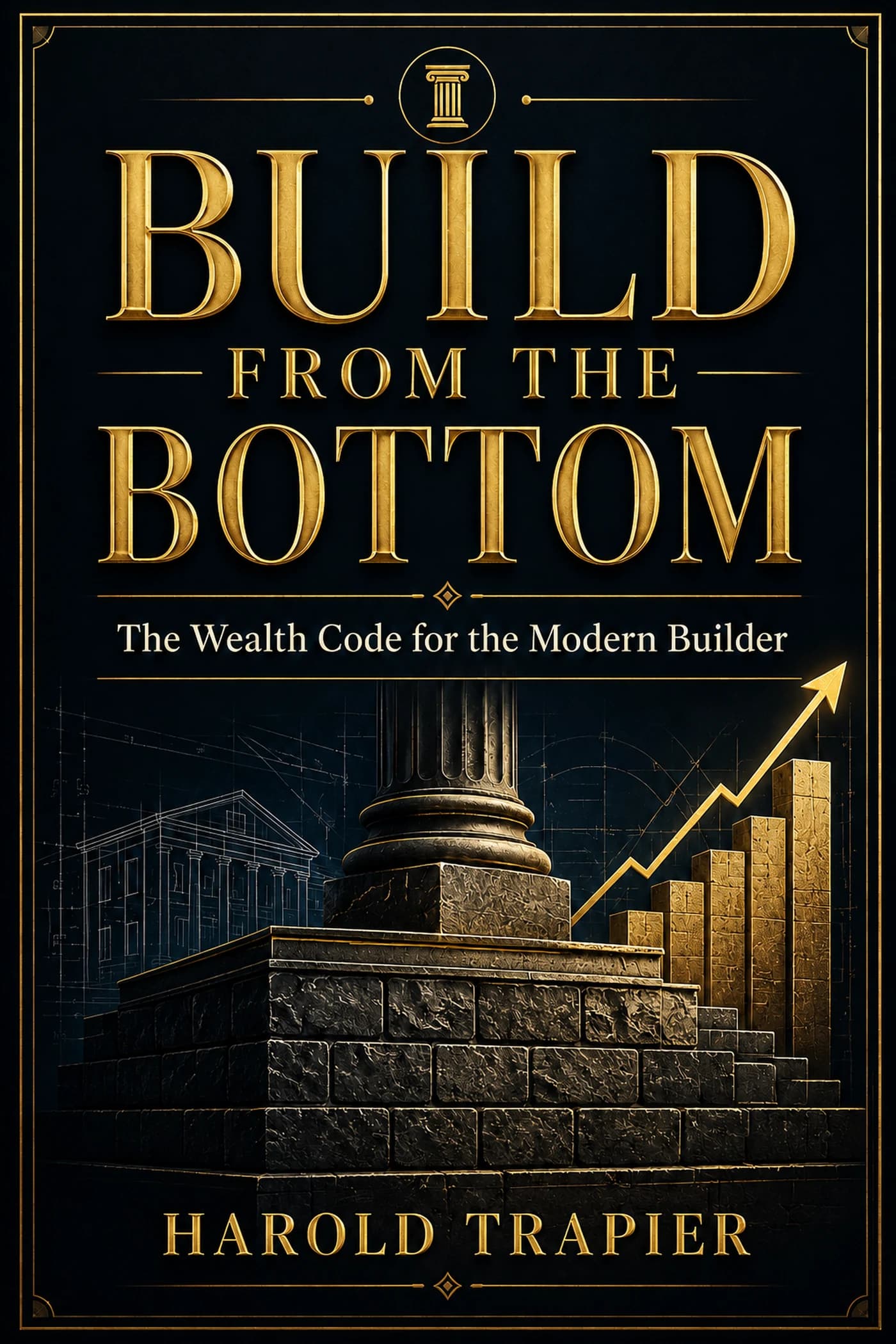
Build From the Bottom — the book, the workbook, and the Builder OS. See the offers
Build True. Build Deep. Build to Last.
You do not need perfect conditions, major funding, elite connections, or a flawless starting point to build something meaningful. You need discipline, systems, leverage, persistence, and the willingness to build from where you are.
The problem
The advice available to someone starting from the bottom is either abstract encouragement or tactics designed for people who already have capital, audience, and time. Neither survives contact with a full schedule and a thin margin.
So effort gets spent, momentum builds and collapses, and a year passes with more activity than progress. The missing piece is almost never desire. It is a system that keeps working on the days desire does not.
The transformation
The framework
The Laws are the spine of the book. Every one of them opens with a historical builder — the Haya smelters of Tanzania, the Mali Empire, Sundiata Keita — and reads that history as instruction rather than heritage.
You cannot build a durable life, business, system, or legacy from a false premise. Every strong build starts with an honest reading of reality.
The first Law is first because every other one depends on it. Build from an accurate reading of your market, finances, skills, relationships, and capacity and you have a foundation. Build from the version that sounds better in public and you have a plan that dissolves on contact with reality. Truth is treated here as a structural requirement, not a virtue.
Builder’s Move
Take the part of your build you have been describing optimistically and write down what is actually true about it — the real numbers, the real capacity, the real constraints.
pp. 23–31· principle quoted, commentary summarised
Income pays you once. A system pays you repeatedly. The builder who owns the mechanism that produces value — not just the labor that delivers it — controls the terms of their financial life.
The distinction between selling labour and owning the mechanism that produces value is the difference between a job and an asset. The Law works through what it takes to move from one to the other: identifying where the business depends on you personally, and converting that dependency into something documented, transferable, and owned.
Builder’s Move
Find the one task only you can currently perform that the business most depends on, and spend two focused hours writing a process document precise enough for a qualified person to execute it without you.
pp. 45–55· principle quoted, commentary summarised
The builder who leaves only finished work leaves a collection of outputs. The builder who leaves a blueprint — documented systems, governance frameworks, transferable knowledge, reproducible processes — leaves a structure that others can operate, adapt, and build on.
Late in the book the frame widens from building something to leaving something that outlasts you. The argument is that documented judgment is more durable than finished output: what survives is not the work itself but the reproducible method behind it, written down clearly enough for someone else to run.
Builder’s Move
Identify the recurring decision where your judgment most determines the outcome, and write down the criteria you actually use — the inputs, what good looks like, and how it usually goes wrong.
pp. 362–374· principle quoted, commentary summarised
Three of the 36. Each principle is quoted from the book; the commentary beneath it is summarised. In print each Law runs about eleven pages.
The system
Each piece stands on its own. Together they close the loop between reading something, deciding to act on it, and actually running it week to week.
Part one
The complete text and the full 36 Laws framework — the philosophy, the reasoning, and the commentary behind each Law.
Explore the bookPart two
A printable companion that turns every Law into reflection, a Builder's Move, an AI prompt, and a commitment you can hold yourself to.
See the workbookPart three
A private Notion execution environment: the 36 Laws Database, trackers, prompt library, builder tools, and a weekly command center.
Inside the Builder OSWhat is included
Who it is for
This is not written for people optimising an already-good position. It is written for people building the position itself.
How it works
Work through the 36 Laws and the operating philosophy behind them.
Use the Builder Self-Audit and Builder Baseline to describe where you actually stand.
Convert each Law into a reflection, a Builder's Move, and a commitment you can check.
Run the 30-Day Build Tracker and Weekly Command Center inside your private Notion workspace.
The author
Harold Trapier is a U.S. Army veteran, operations leader, business builder, and AI and technology consultant, and the founder of Trapier Management LLC. His work spans leadership, logistics, process improvement, business systems, and government contracting.
Build From the Bottom comes out of that background: the parts of operations, discipline, and systems thinking that transfer directly to building something of your own, written for people who are starting without the advantages that most business advice quietly assumes.
Read the full story →Choose your entry point
Start with the book, add the workbook, or take the complete execution system.
The full Build From the Bottom text and the complete 36 Laws framework.
Available on Amazon
The printable companion that turns each Law into reflection, an exercise, and a written commitment.
Not yet published
The private Notion execution environment behind the framework.
Not yet published
Access is delivered after purchase. Update terms are confirmed at the time of purchase.
Full comparison on the purchase page.
Placeholder — no reviews yet
Reader responses will appear here once the book is in readers’ hands. Nothing is shown in this space until there is a real, attributable quote to show.
Stay in the loop
Occasional notes on the Laws, the build, and what is shipping next. No noise, and you can leave whenever you want.
Questions
Three things, depending on the offer you choose. The book is the full text and the complete 36 Laws framework. The workbook is a printable companion that converts each Law into reflection, an exercise, and a commitment. The Builder OS is a private Notion workspace containing the 36 Laws Database, Builder Self-Audit, Builder Baseline, 30-Day Build Tracker, AI Prompt Library, Builder Tools, and a Weekly Command Center.
No. The framework is built for anyone constructing something durable from a position without obvious advantages — a business, a career change, a skill, a body of work. The Laws are about discipline, systems, leverage, and persistence, and they apply wherever those apply.
The book is complete on its own. The workbook exists because reading and executing are different activities, and most people who only read do not act. If you already have a strong personal execution system, the book may be sufficient. If you do not, the workbook is the part that makes the difference.
The Builder OS is a private execution environment built in Notion. It holds the databases, trackers, prompts, and templates that run the system week to week. It is delivered as a template you copy into your own Notion account, so you control your own data. No prior Notion experience is required; access instructions are sent after purchase.
There are no video modules, no drip schedule, and no cohort to keep pace with. This is a body of written work plus the tooling to execute against it, on your own timeline. You are buying a framework and an operating system, not a curriculum.
Formats are being finalized. This page will be updated with the confirmed list before launch rather than announcing formats that are not yet ready.
Purchases are made on Amazon, so anything about payment, delivery or returns goes through Amazon. For questions about the products themselves, use the contact page and choose Purchase support — include your Amazon order number.
Harold Trapier — a U.S. Army veteran, operations leader, business builder, and AI and technology consultant, and the founder of Trapier Management LLC. The About page covers why the book exists.
You already have the only starting position you are going to get. The question is whether you build on it.