Part I — The Foundation
Why most people build too high too fast, the Five Builder Questions, and African history read as builder instruction rather than as heritage.
Build From the Bottom — the book, the workbook, and the Builder OS. See the offers
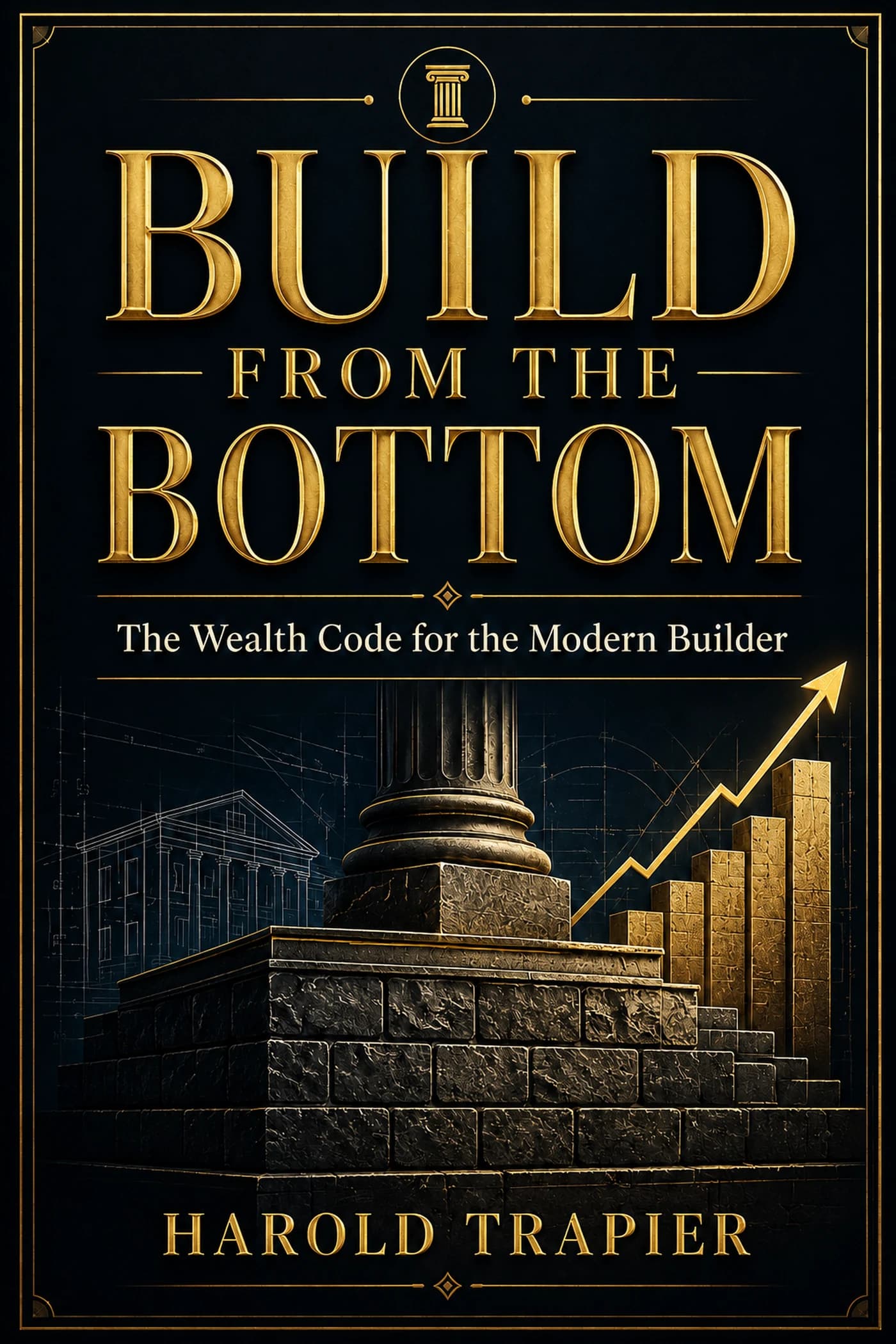
The book
The Wealth Code for the Modern Builder
A book for people building something real from a position without obvious advantages — written around an original framework of 36 Laws covering foundation, systems, leverage, and endurance.
What it is
Build From the Bottom is organised around a single claim: the conditions you are waiting for are not coming, and the build has to be designed for the conditions you actually have.
Each Law states a principle, explains the reasoning behind it, and ends with a Builder’s Move — the specific action the Law asks for. The book is meant to be argued with, marked up, and returned to, not read once.
The philosophy
You do not need perfect conditions, major funding, elite connections, or a flawless starting point to build something meaningful. You need discipline, systems, leverage, persistence, and the willingness to build from where you are.
That is not encouragement. It is a design constraint. If the plan requires funding you do not have, a network you have not built, or a version of yourself who never has a bad month, then it is not a plan you can execute — and the book treats that as a structural problem to solve rather than a personal failing to push through.
From the book
“Truth is not the obstacle to ambition. It is the prerequisite for it.”
The framework
The book runs in three parts. The Laws are the middle and the largest, framed by the foundation that precedes them and the operating system that puts them to work.
Sample
Every Law carries a core principle, a historical builder story, business and personal application, an AI leverage prompt, a Builder's Move, and a warning. The three below quote the principle and summarise the rest — each runs about eleven pages in print.
You cannot build a durable life, business, system, or legacy from a false premise. Every strong build starts with an honest reading of reality.
The first Law is first because every other one depends on it. Build from an accurate reading of your market, finances, skills, relationships, and capacity and you have a foundation. Build from the version that sounds better in public and you have a plan that dissolves on contact with reality. Truth is treated here as a structural requirement, not a virtue.
Builder’s Move
Take the part of your build you have been describing optimistically and write down what is actually true about it — the real numbers, the real capacity, the real constraints.
pp. 23–31· principle quoted, commentary summarised
Income pays you once. A system pays you repeatedly. The builder who owns the mechanism that produces value — not just the labor that delivers it — controls the terms of their financial life.
The distinction between selling labour and owning the mechanism that produces value is the difference between a job and an asset. The Law works through what it takes to move from one to the other: identifying where the business depends on you personally, and converting that dependency into something documented, transferable, and owned.
Builder’s Move
Find the one task only you can currently perform that the business most depends on, and spend two focused hours writing a process document precise enough for a qualified person to execute it without you.
pp. 45–55· principle quoted, commentary summarised
The builder who leaves only finished work leaves a collection of outputs. The builder who leaves a blueprint — documented systems, governance frameworks, transferable knowledge, reproducible processes — leaves a structure that others can operate, adapt, and build on.
Late in the book the frame widens from building something to leaving something that outlasts you. The argument is that documented judgment is more durable than finished output: what survives is not the work itself but the reproducible method behind it, written down clearly enough for someone else to run.
Builder’s Move
Identify the recurring decision where your judgment most determines the outcome, and write down the criteria you actually use — the inputs, what good looks like, and how it usually goes wrong.
pp. 362–374· principle quoted, commentary summarised
Intended readers
Formats
Formats are still being finalised. This section will list the confirmed editions once they exist — nothing is announced here before it is real.
Placeholder
Format one — to be confirmed
Placeholder
Format two — to be confirmed
Placeholder
Format three — to be confirmed
No publication date, ISBN, rating, or review count is listed on this site until those details are confirmed.
Go further
Reading changes what you know. The workbook and Builder OS change what you do with it.
Add
A printable companion that turns every Law into reflection, a Builder's Move, an AI prompt, and a written commitment.
See the workbookAdd
The private Notion execution environment where the audit, baseline, tracker, and weekly review actually run.
Inside the Builder OS